14 Facts About Valparaiso That Will Surprise You
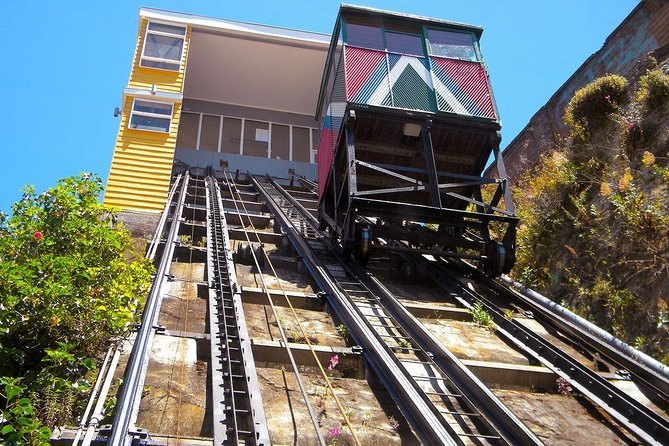
The short answer. A canal on the other side of the continent ended this city's boom. Its parliament sits here rather than in the capital. Its funicular lifts are not a curiosity beside the World Heritage listing — they are part of what was listed. And one of them travels straight up inside a shaft. Fourteen facts below, each one traceable to the body that publishes it.
Valparaiso is one of those places where the interesting things are structural rather than decorative. The colours get the photographs; the reasons behind them are better. Here are fourteen, and if any of them makes you want to see it, tour to valparaiso are compared side by side.
1. The Panama Canal ended the boom
Valparaiso was the first and most important merchant port on the Pacific routes that linked the Atlantic and the Pacific by way of the Strait of Magellan. Its commercial peak ran from the 1880s until the Panama Canal opened in 1914 and ships stopped coming round the bottom of the continent. Growth slowed, and the historic fabric survived because nobody could afford to replace it.
2. UNESCO listed the transport system, not just the buildings
The 2003 inscription under criterion (iii) covers the urban layout, the public spaces, the port and naval heritage around Prat Pier — and explicitly the funicular elevator and trolleybus systems. The way you move around this city is itself World Heritage.
3. Chile's Congress does not sit in the capital
The National Congress has met in Valparaiso since the 1990s, in a modern building in the Almendral, the flat quarter east of the port. Santiago has the presidency and the ministries; the legislature is here, forty minutes from the sea.
4. The first lift opened in 1883
Ascensor Concepción began running on 1 December 1883, and the idea spread fast because the alternative was a staircase. Around thirty were eventually built.
5. Fifteen of them are national monuments
On 1 September 1998 the Consejo de Monumentos Nacionales declared fifteen ascensores historic monuments, citing their historic, social and tourist value. Ascensor Reina Victoria was covered by Decreto Nº 866.
6. One lift is not an incline at all
Ascensor Polanco, built between 1913 and 1915 by Easton Lift Co., runs vertically inside a shaft rather than up a hillside slope, reached through a tunnel in the rock. It was declared a monument in 1976, twenty-two years before the others.
7. One was built for stretchers
Ascensor Van Buren opened in 1929 to replace a funicular destroyed by the 1906 earthquake, and it was built to hospital specifications — larger than the others, so that patients and medical equipment could be carried up to the hospital it serves.
8. Six lifts are running today
The register that tracks them lists Reina Victoria, El Peral, Cordillera, San Agustín, Barón and Van Buren as operating, with Espíritu Santo and Concepción recovered and in trial running. Which six are working changes, which is why a guide who rode one this week beats a guidebook printed last year.
9. The city is older than you would guess
Valparaiso was founded in 1536, eighty years before the Mayflower sailed, though almost nothing from that century survives above ground. The 2024 census counted 284,938 people.
10. The wine country is barely forty years old
The Casablanca Valley you pass on the road from Santiago had no commercial vineyards until 1982, when Pablo Morandé planted the first ones. It took its own denomination of origin on 14 December 1994, and now has roughly 5,800 hectares under vine.
11. Its wine is cool because of a current
The Humboldt Current runs cold water up this coast, and the morning fog it throws inland is what keeps the Casablanca Valley cool enough for Sauvignon Blanc and Chardonnay in a latitude that would otherwise be too warm for them.
12. Palacio Baburizza holds one of Chile's four great collections
The fine arts museum on Paseo Yugoslavo has been assembling its collection since 1895 and is counted among the four most important in the country. General admission is CLP 4,000 and foreign visitors pay CLP 6,000.
13. It rains 230 times more in June than in January
The city's own weather station records 0.7 mm of rain across the whole of January and 161.7 mm in June. That is not a seasonal shading; it is two different climates in one place, and it is the single fact that should decide when you come.
14. The port is still a working port
None of this is preserved in aspic. Valparaiso remains a container, copper and fruit port, and the 2026–27 cruise season brings 30 ship calls between 5 October and 15 April, nine of them staying at least one night. The cranes you photograph from the paseos are working cranes.
Want these in order, on the ground? The lifts, the paseos and the port sit within an hour's walk of each other, which is what a guided Valparaiso tour is for.
The six lifts you can actually ride
Numbers three to eight above are easier to hold as a table. These are the ascensores the register lists as running, with the year each one opened and the hill it climbs.
| Lift | Opened | Climbs to | What is unusual about it |
|---|---|---|---|
| Ascensor Concepción | 1883 | Cerro Concepción | The first in the city; recovered and in trial running |
| Ascensor Artillería | 1892 | Cerro Artillería | The third built; reopened 31 October 1914 after an extension |
| Ascensor Cordillera | 1894 | Cerro Cordillera | First inaugurated in 1886 and rebuilt after a fire |
| Ascensor Reina Victoria | 1902 | Cerro Concepción | Declared a monument by Decreto Nº 866 |
| Ascensor El Peral | 1902 | Cerro Alegre | Municipal; runs 7am to 9:30pm |
| Ascensor Polanco | 1913–15 | Cerro Polanco | Vertical inside a shaft, and a monument since 1976 |
If you want to ride two of them without working out which are open this week, the guided walks do it for you and put the tickets inside the fare. Which hill each one lands on is set out on the neighborhoods page.
Which of these can you see in one day?
More than you would think, because the facts above are geographically concentrated. Plaza Sotomayor, two lifts, both famous cerros and the view over the working port sit inside an hour's walk of each other, and you can do the lot in a morning.
What does not fit in a day is the wine. The Casablanca Valley is forty-five minutes inland over the coastal range, which makes it an afternoon of its own or part of a day trip from Santiago. The wine tours page sets out what each one covers, and the visiting page has the rest of the costs.
Where do these facts come from?
- The inscription, the criterion and what was listed: UNESCO's World Heritage Centre.
- The lifts, their dates and their monument status: Chile's Consejo de Monumentos Nacionales, and the register that tracks which are running.
- The museum figures: the Museo de Bellas Artes de Valparaiso and the Fundación Pablo Neruda.
- The rainfall: the Dirección Meteorológica de Chile 1991–2020 normals, via the weather page.
- The cruise season: Puerto Valparaiso, through getting there.
Most of these are a walk apart. The three below put the lifts, the paseos and the port into one morning or one day; the rest are compared on Valparaiso Tours.
Tours that show you all of this
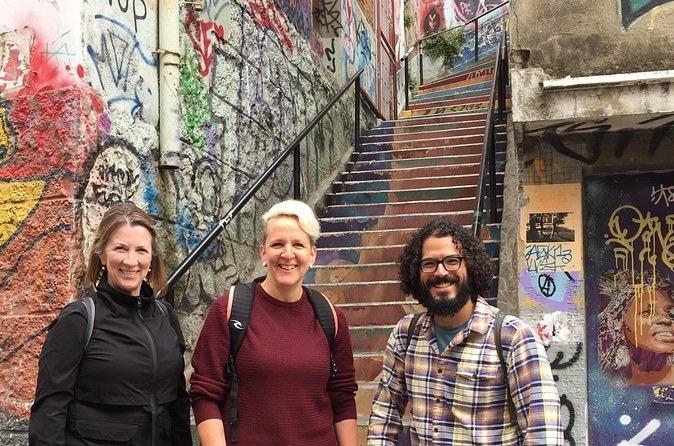
Guided Panoramic Tour in Valparaíso
The lifts rather than the stairs: three and a half hours, and step-free by its operator.
From $40 per person
Check Availability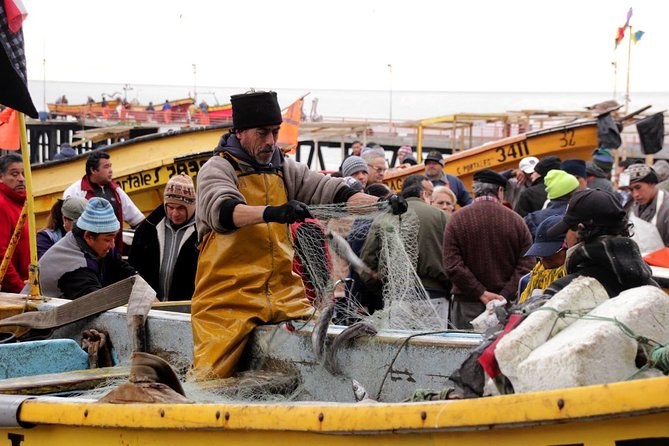
Valpo in 1 day: Authentic + Famous! Semi-private walking tour & public transport
Seven hours on trains, trolleybuses and funiculars, through the markets and over both cerros.
From $80 per person
Check Availability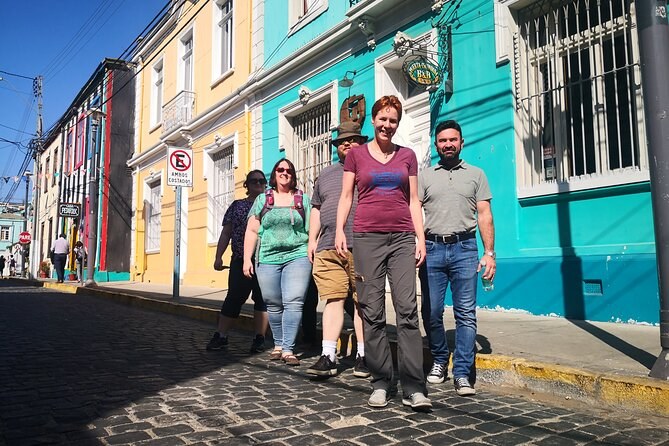
Private tour in Valparaiso from Valparaiso CruiseTerminal to Stgo
A private guide-driver from the cruise terminal to Santiago, two and a half hours in the city.
From $284 per person
Check Availability